By Bailey Little and Angela McLinton
As a college town, Boone offers many opportunities for students and younger people to volunteer within the community, but also has programs geared toward older participants to make a difference in the community.
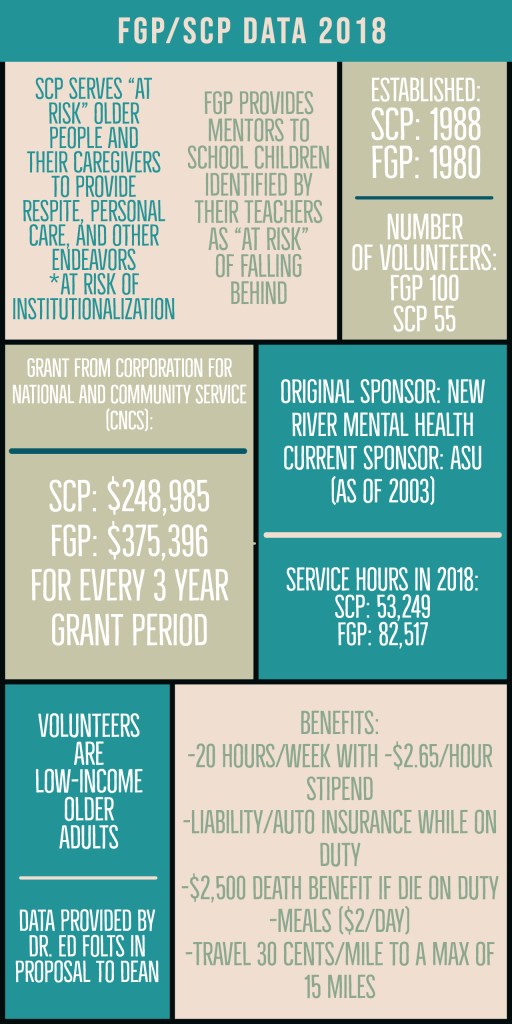
Appalachian Senior Programs is a parent organization sponsored by Appalachian State University that serves Alleghany, Ashe, Avery, Watauga and Wilkes counties. The Appalachian Senior Companion Program and Appalachian Foster Grandparent Program are housed within the organization. The FGP and SCP were established in 1980 and 1988, respectively.
Debbie Wellborn, who serves as the SCP director and has been involved with the programs since 1988, said that some seniors prefer working with children while some prefer to work with their peers.
“We are thrilled and honored that we can offer seniors either or and they can make that decision,” Wellborn said about the flexibility the programs offer volunteers. “The senior companions serve as their hands, feet and eyes. Routine tasks such as helping them read the labels at the grocery store or helping those who are blind get around safely are all typical tasks of those who volunteer.”
Both programs help provide reassurance to caregivers of their older loved ones, as well as working parents who are unable to spend as much time doing homework with their children, that those they care for are being taken care of and their basic needs are met.
In 2003, the sponsor of the programs shifted from New River Mental Health to the university. The university’s Department of Sociology is the campus liaison to the two programs. Dr. Ed Folts and Dr. Amy Page are involved with the grants.
“The requirements of a sponsor are that it be a nonprofit corporation, which we supply for them all of the accounting, all of the accountability, and the administrative work that’s involved,” said Folts, professor and executive director of Appalachian Senior Programs.
Folts explained how foster grandparents serve in school systems, the head start program and other places. They work with young people who have been identified as being at risk of not making their grade level learning goals. The volunteers are supervised usually by the classroom teacher.
Senior companions work with other seniors who are more advanced in age or have specific conditions that do not require any nursing background. Overall, they strive to be a companion and provide conversation and interaction, as well as basic needs services that allow them to stay in their own home. Senior companions offer many services, but most important among them are respite for caregivers, Folts asserted.
“[Older people] usually seek help from family members, but the family members get burned out really quickly,” Folts said. “So what senior companions do is they go in and they essentially provide those services that a caregiver would, with some limitations, and give the caregivers some time off.”
Folts said volunteers need only to be a low-income elderly person. Once accepted and background-checked, doctors certify that they are physically capable of volunteering.
“I don’t imagine too many people will talk about $2 an hour as a major benefit of doing this. Mostly it’s getting rewards of serving other people,” Folts said of the mutually beneficial relationship between volunteers and recipients.
There are 155 volunteers in the organization, as of last year’s data.
“They’re always trying to recruit new volunteers,” Folts suggested. “In this age group, illness and death is a reality, so we always need new faces.”
Following Folts’ retirement, Page will become executive director. Although Folts will no longer be employed at App State, the two plan on remaining in contact and continuing to collaborate.
“I’ve always had the belief that education and academia are great and they provide pieces of information for us and research is absolutely necessary, but if we can’t apply any of that in tangible ways to elevate people’s daily lives, then for me it’s pointless,” Page said.
According to Page, providing transportation to medical appointments for the older members of the community is even more important considering how rural the five counties are because people tend to live further away from one another.
“We’re also seeing that even in the existing population that we have who is aging, people seem less concerned about ‘what can I do to give back’? It’s a very different sort of generational philosophy,” Page said.
Sources:
- Dr. Ed Folts, executive director of Appalachian Senior programs, sociology professor. In-person interview 9/27 in his office. Contact: foltswe@appstate.edu
- Dr. Amy Page, successor to Folts, sociology professor. In-person interview 10/2 in her office. Contact: pagead@appstate.edu
- Debbie Wellborn, program director for the Senior Companion Program. In-person interview 10/4 in her office. Contact: appalachianseniorprogams@gmail.com
- https://aseniorprograms.wixsite.com/website/who-we-are
- Data sheet provided by Dr. Folts for the last fiscal year


 My Journalism Journey